Stage set for IFFI 2025: Parade, premieres and record participation await
The parade will be led by the state tableaus of Andhra Pradesh, Haryana, and Goa, each presenting a portrait of the state’s identity and imagination.
As part of a landmark move to strengthen India–Korea relations in media, education, and culture, a chain of new partnership initiatives has been initiated with regard to academic exchanges, collaborative research, and capacity-building exercises.




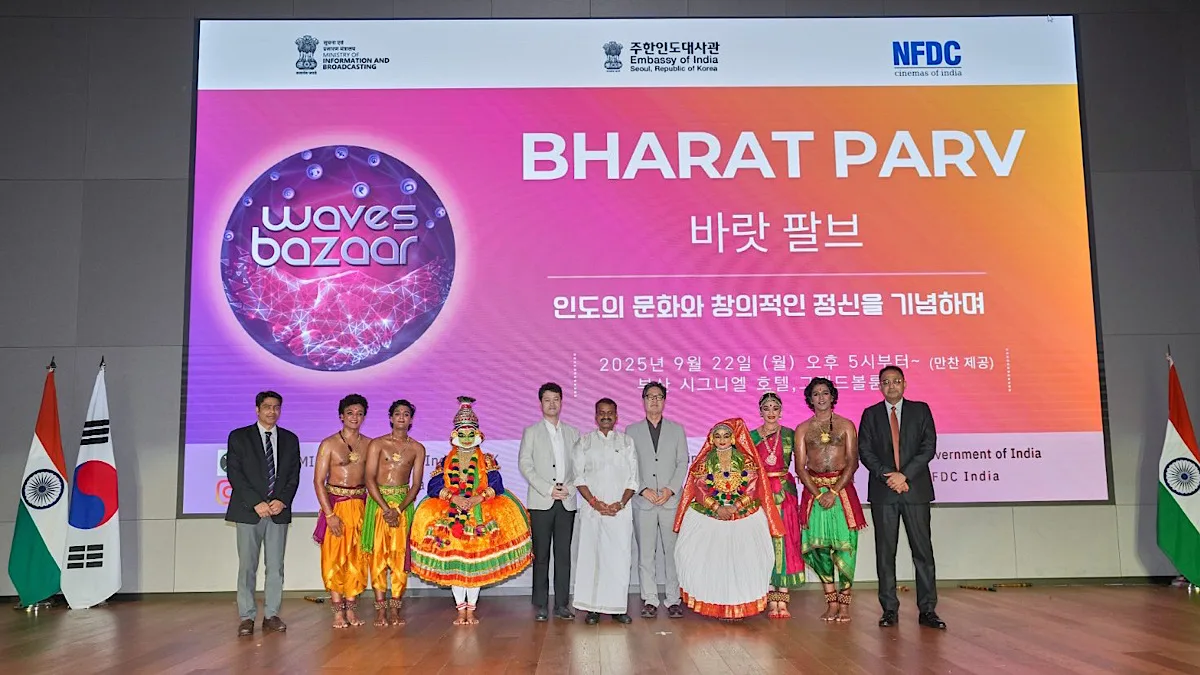
Photo:SNS
As part of a landmark move to strengthen India–Korea relations in media, education, and culture, a chain of new partnership initiatives has been initiated with regard to academic exchanges, collaborative research, and capacity-building exercises. These initiatives encompass student and teacher exchange programmes, the opening of an India–Korea Research Centre, and professional training modules designed to promote global learning, cross-cultural understanding, and India’s educational diplomacy in East Asia.
According to the Ministry of Information and Broadcasting, the collaboration was conducted during the recent visit of the Indian Institute of Mass Communication (IIMC) and the Film and Television Institute of India (FTII) delegations to Busan, Republic of Korea.
Advertisement
Prof. (Dr.) Pramod Kumar, Department Head of Strategic Communication at the IIMC, discussed academic cooperation in international communication, diplomacy, and cultural studies with Busan University of Foreign Studies (BUFS) officials. While on his visit, Prof. Kumar also met with Prof. Soon-Cheul Lee, Head of the India Centre at the BUFS. Both institutions have, since then, exchanged preliminary versions of a Memorandum of Understanding (MoU), which is likely to be agreed upon after consultations with the Ministry of Information and Broadcasting.
Advertisement
India’s attendance at the Busan International Film Festival (BIFF) 2025, Asian Contents and Film Market (ACFM), and related institutional exchanges in Busan, Republic of Korea, was a landmark moment towards increasing India–Korea collaborations. The delegations’ visit led to meaningful scholarly exchange and high-value sector exposure, with the ministry citing India’s increasing activity in East Asia’s creative economy.
The partnerships that are set to enhance academic mobility, promote cross-border research, and boost India’s educational diplomacy in East Asia comprise exchange programmes for students and faculty to enhance cross-cultural learning, joint teaching modules in communication and diplomacy, and industry-focused curricula development.
The two countries also aim to set up an India–Korea Research Centre to conduct collaborative projects in foreign policy and international relations, host international research forums, and initiate co-supervised doctoral and joint PhD programmes.
Specialised workshops, professional development upskilling courses, and faculty development programmes integrating Korean pedagogy are being launched to strengthen capacity and deepen academic collaboration between the two countries.
Prof. Mangal Dhawaj Negi, Department Head, Direction and Production, FTII, visited the BIFF 2025 and the accompanying industry sessions. During the visit, Prof. Negi engaged in several significant bilateral and cultural interactions, including the opening of the Bharat Pavilion, international filmmakers’ networking sessions, and meetings with the Korean Film Council (KOFIC) and the Korean Academy of Film Arts (KAFA).
At a bilateral meeting at KOFIC headquarters, the KOFIC Chairman committed to furthering a Letter of Intent (LoI) between FTII and KAFA to open the doors to academic exchanges, joint workshops, and collaborative film productions between the two world-class film institutions.
Advertisement